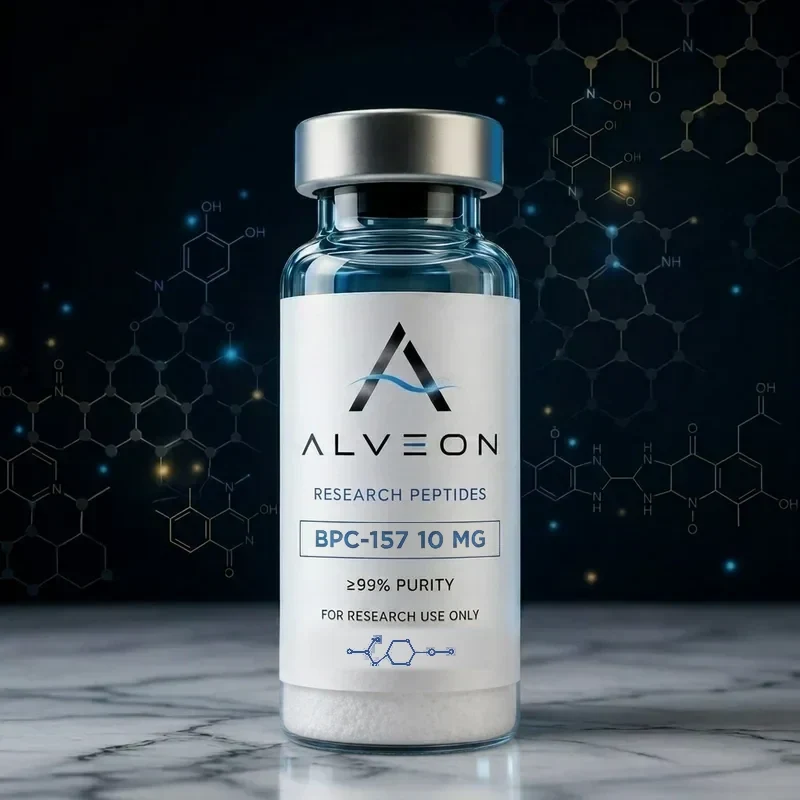


A peptide can look acceptable on a product listing and still create avoidable uncertainty at the bench. For teams working with receptor assays, cell models, signaling pathways, or stability-sensitive materials, research peptides are not interchangeable inputs. Identity, purity, handling history, and lot-level documentation directly affect whether an observed result can be trusted, repeated, and defended.
The procurement decision begins well before a vial enters the laboratory. A qualified supplier should make the quality case visible: analytical testing, batch traceability, storage requirements, and controlled fulfillment. Price has a place in procurement. It should not replace verification.
What Defines Research-Grade Peptides?
Research peptides are synthetic amino acid sequences supplied for controlled scientific investigation. Their applications span metabolic and incretin signaling, tissue repair pathways, endocrine research, mitochondrial function, neuroprotection, and cognitive research. Depending on the compound and study design, a peptide may be evaluated for receptor binding, downstream signaling, cellular responses, degradation behavior, or pathway interactions.
The phrase "research grade" is meaningful only when supported by documentation. A supplier's claim of high purity is not equivalent to a demonstrated analytical result. Laboratories need a clear connection between the material received and the evidence supporting that material's identity and composition.
For many workflows, purity of 99% or higher, verified by high-performance liquid chromatography (HPLC), is an important starting point. It is not the only criterion. HPLC can characterize purity profiles, but researchers should also consider identity confirmation, residual solvents, moisture content where relevant, peptide content, packaging integrity, and storage conditions. The appropriate specifications depend on the experimental system and the risk tolerance of the protocol.
A highly sensitive receptor assay may require a different level of characterization than an early exploratory screen. That does not mean documentation becomes optional. It means the acceptance criteria should match the scientific question.
Why Batch Documentation Matters
A certificate of analysis, or COA, is a practical control point between a supplier's quality claim and a laboratory's incoming-material process. At minimum, the document should be traceable to the lot or batch number on the product label. It should identify the compound, report the relevant analytical result, and provide sufficient detail for the laboratory to confirm it has received the intended material.
Third-party COAs add independence to the verification process. They help reduce reliance on unsubstantiated marketing language and provide a defined record for procurement files, protocol documentation, and internal review. For recurring studies, lot-level records also make it easier to investigate changes in experimental behavior if they occur.
Purity Is Not a Complete Quality System
A purity percentage is useful, but it does not answer every question. A 99% HPLC result describes the relative abundance of the target peak under a specific analytical method. It does not automatically establish that a material was stored correctly, that its label matches its contents, or that the lot will arrive in usable condition.
Quality is cumulative. It includes verified composition, appropriate packaging, controlled handling, accurate labeling, and disciplined logistics. When one element is missing, the laboratory absorbs more uncertainty.
Traceability Supports Repeatability
Repeatability depends on more than standardized assay conditions. The material itself must be traceable. Record the supplier, product identifier, lot number, receipt date, storage location, reconstitution details, and use history. These records can be simple, but they should be consistent.
If a signal shifts between experiments, lot traceability gives the team a way to assess whether the source material may be a contributing variable. Without it, troubleshooting becomes slower and less conclusive.
Controlled Handling Is Part of the Specification
Peptides can be sensitive to temperature, moisture, repeated freeze-thaw cycles, light exposure, and inappropriate solvent selection. A material may leave a supplier with acceptable analytical results but lose utility if handling controls fail in transit or after receipt.
Cold-chain shipping is therefore more than a delivery feature. It is part of maintaining the conditions under which the material was tested and released. Packaging should be selected for the compound's stated storage needs and anticipated transit time. On receipt, laboratory staff should inspect the shipment, verify the lot against the COA, document any temperature-control indicators if provided, and transfer the material to the recommended storage environment without delay.
Lyophilized peptides and solutions in storage require different considerations, including solvent quality, concentration accuracy, aliquoting strategy, and storage duration. Well-documented internal handling procedures help limit variation between operators and experiments.
Avoid treating a vendor's generic handling statement as a complete protocol. The peptide sequence, formulation, experimental concentration, and intended storage period all matter. When stability is central to the study, establish and document conditions through the laboratory's own method development work.
Evaluating a Research Peptide Supplier
Supplier evaluation should be a technical review, not a catalog comparison alone. Begin with the evidence available for a specific product and lot. Can the supplier provide batch-level COAs? Is HPLC purity reported clearly? Are testing practices and handling expectations described in a way that a laboratory can assess? Can the vendor support bulk procurement or institutional requirements without losing lot control?
Reliable communication is also part of the qualification process. Research teams often need clarification on documentation, packaging, fulfillment timing, or larger-volume requests. A supplier that understands laboratory procurement should be able to answer directly and provide relevant records without vague assurances.
For high-demand categories such as incretin research compounds, repair-pathway peptides, GH secretagogues, and nootropic research materials, availability can create pressure to purchase quickly. That pressure should not lower the documentation standard. A product name alone does not establish quality.
Research Peptides in a Controlled Workflow
Once materials are received, consistency depends on how they are integrated into the study. Assign a unique internal identifier, retain the original lot information, and establish a chain of custody from receipt through use. If several team members prepare solutions, specify the approved solvent, target stock concentration, aliquot size, labeling format, and discard criteria.
Controls deserve equal attention. A vehicle control may help identify solvent-related effects. Reference materials, where scientifically appropriate, can support assay performance monitoring. Replicates and predefined acceptance criteria help distinguish a meaningful biological observation from ordinary assay variation.
The same discipline applies when comparing compounds. Two materials that fall into the same broad research category should not be treated as interchangeable — their molecular targets and the experimental questions they suit are rarely identical. A sound protocol begins with the specific mechanism under study, then selects materials and controls accordingly.
Keep Research Use Boundaries Clear
Research peptides should be procured and used only within their designated research context. They are not approved medicines, consumer wellness products, or substitutes for clinical care. Product quality documentation supports scientific work, but it does not convert a research material into a human-use product.
This distinction protects the integrity of the laboratory and the credibility of the resulting data. Qualified teams should maintain appropriate institutional practices, safety procedures, and compliance requirements for their work.
The most useful procurement question is not simply, "Can we obtain this peptide?" It is, "Can we document what it is, how it was handled, and why it is suitable for this experiment?" When the answer is clear before the study begins, the work that follows has a stronger foundation.