

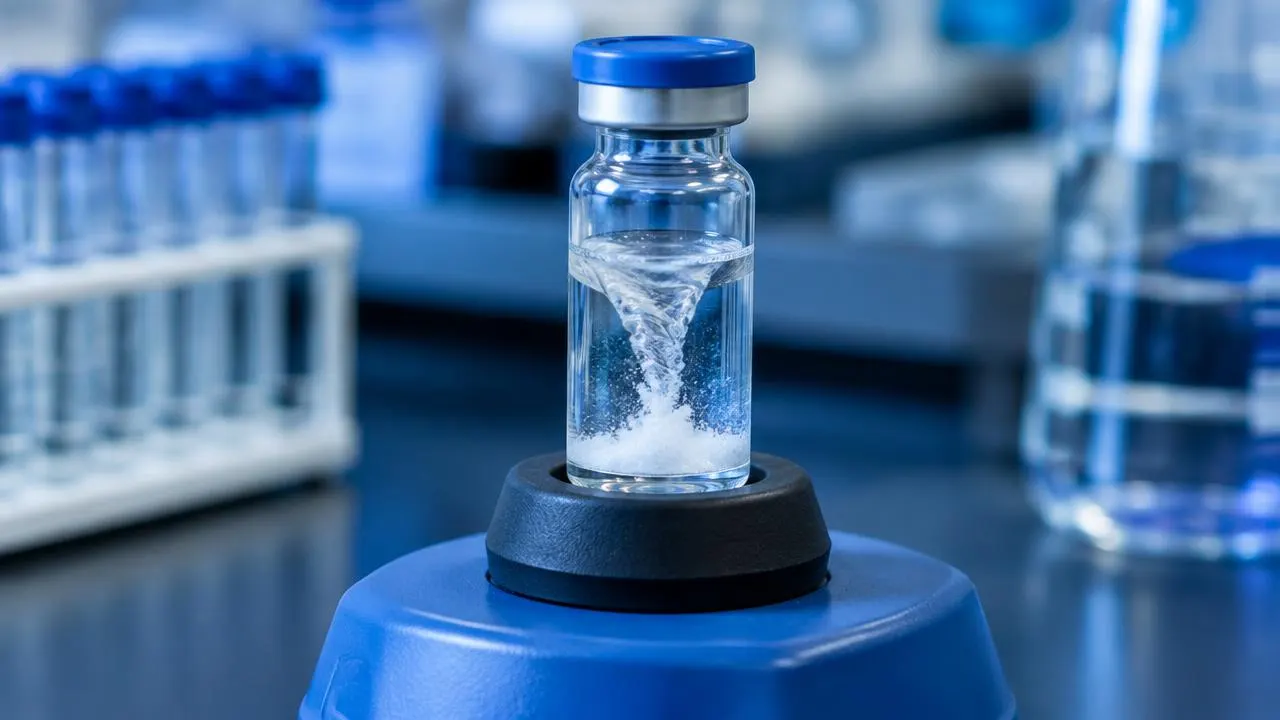
Solubility depends mainly on the balance of charged and hydrophobic residues. Calculating net charge at neutral pH gives a good first prediction.
Estimate net charge
- Count +1 for each Lys, Arg and the free N-terminus.
- Count −1 for each Asp, Glu and the free C-terminus.
- Positive net charge: try water, then dilute acetic acid.
- Negative net charge: try water, then a dilute basic buffer.
- Near zero and hydrophobic: a small amount of organic co-solvent may be needed.
A stepwise strategy
- Test with a small portion first.
- Add solvent to the powder, not powder to solvent.
- Swirl or briefly sonicate; avoid vigorous vortexing.
- Dilute into the final assay buffer slowly.
Cloudiness or gel formation usually signals aggregation; centrifuge before use and confirm concentration if in doubt.