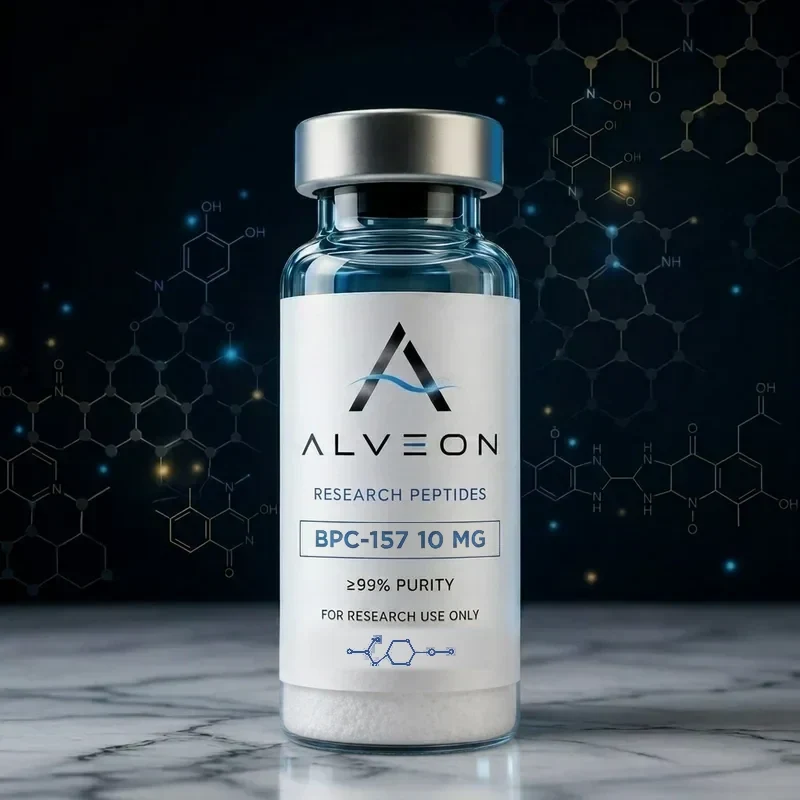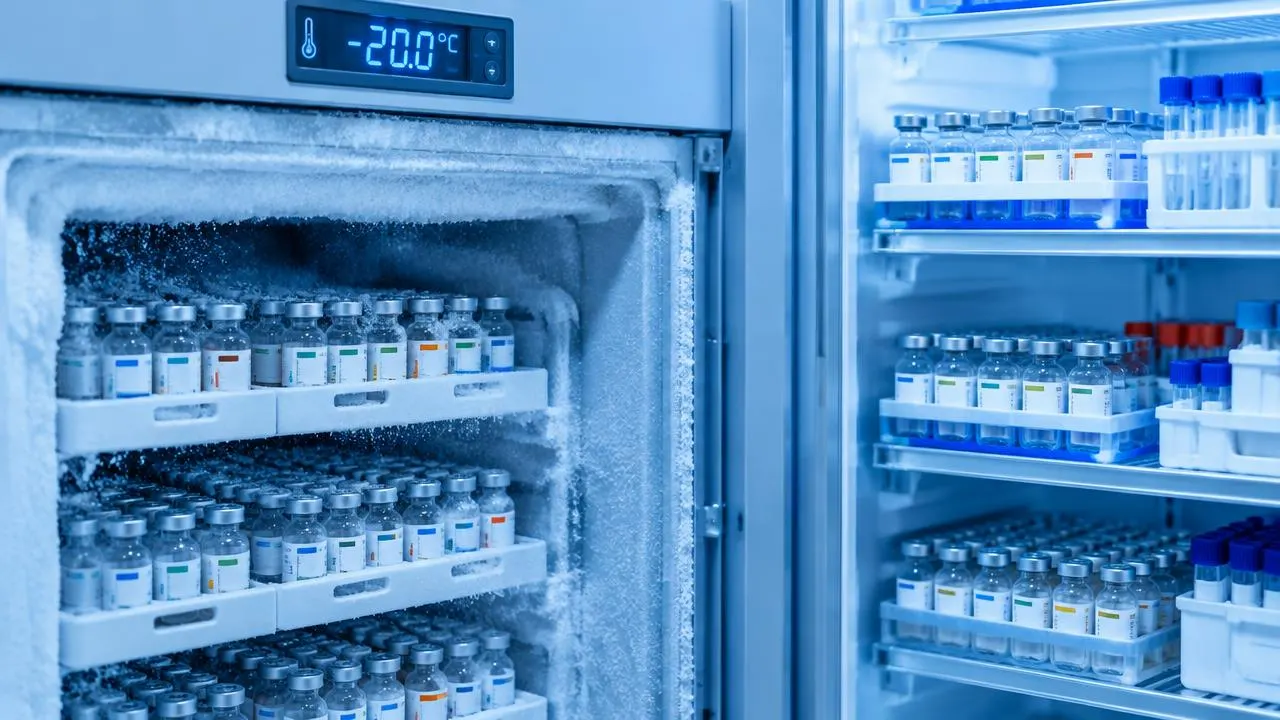

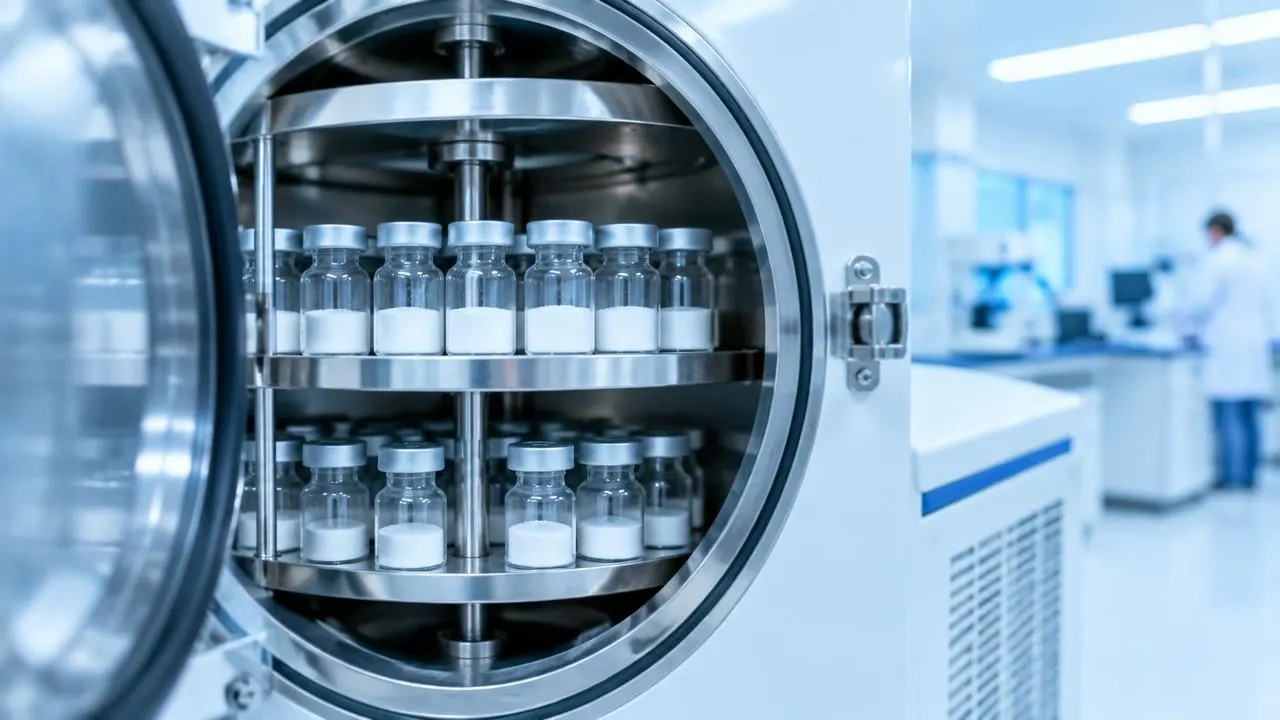
Almost every research peptide arrives as a small cake or loose powder at the bottom of a sealed glass vial. That form is the result of lyophilisation — freeze-drying — and it is the main reason peptides can be shipped worldwide and stored for long periods without losing integrity.
The three stages of freeze-drying
- Freezing: the purified peptide solution is cooled until water forms ice crystals and the peptide is trapped in the frozen matrix.
- Primary drying: under deep vacuum, ice sublimes directly to vapour without passing through a liquid phase.
- Secondary drying: residual bound water is removed by gently raising the shelf temperature, leaving moisture typically below a few percent.
Why lyophilised peptides are more stable
Water drives most peptide degradation pathways — hydrolysis, deamidation and aggregation all need a mobile aqueous phase. Removing it slows these reactions dramatically, which is why a sealed lyophilised vial stored at −20 °C remains suitable for research far longer than any reconstituted solution.
What the powder can tell you
- A uniform white or off-white cake suggests controlled drying.
- A collapsed or glassy residue can indicate drying above the collapse temperature, though the peptide itself may still be intact.
- Colour can be compound-specific — copper complexes such as GHK-Cu are naturally blue.
- Low fill volume is normal: 10 mg of peptide occupies very little space.
Handling tips for the laboratory
Let the vial reach room temperature before opening to prevent condensation, tap the powder to the bottom, and reconstitute only the amount required for the experiment. Record the lot number and date alongside your protocol.
Related reagents: lyophilised peptide reference standards. Each batch ships with documented HPLC purity and a Certificate of Analysis on request.